Impact glass
Lechatelierite (almost pure silica glass) and water content below 300 ppm — too dry to be volcanic.
The impact
Until 2019 the circular valley was often assumed to be a volcanic collapse. Fieldwork and laboratory evidence now show it is Central America's first confirmed meteorite crater.
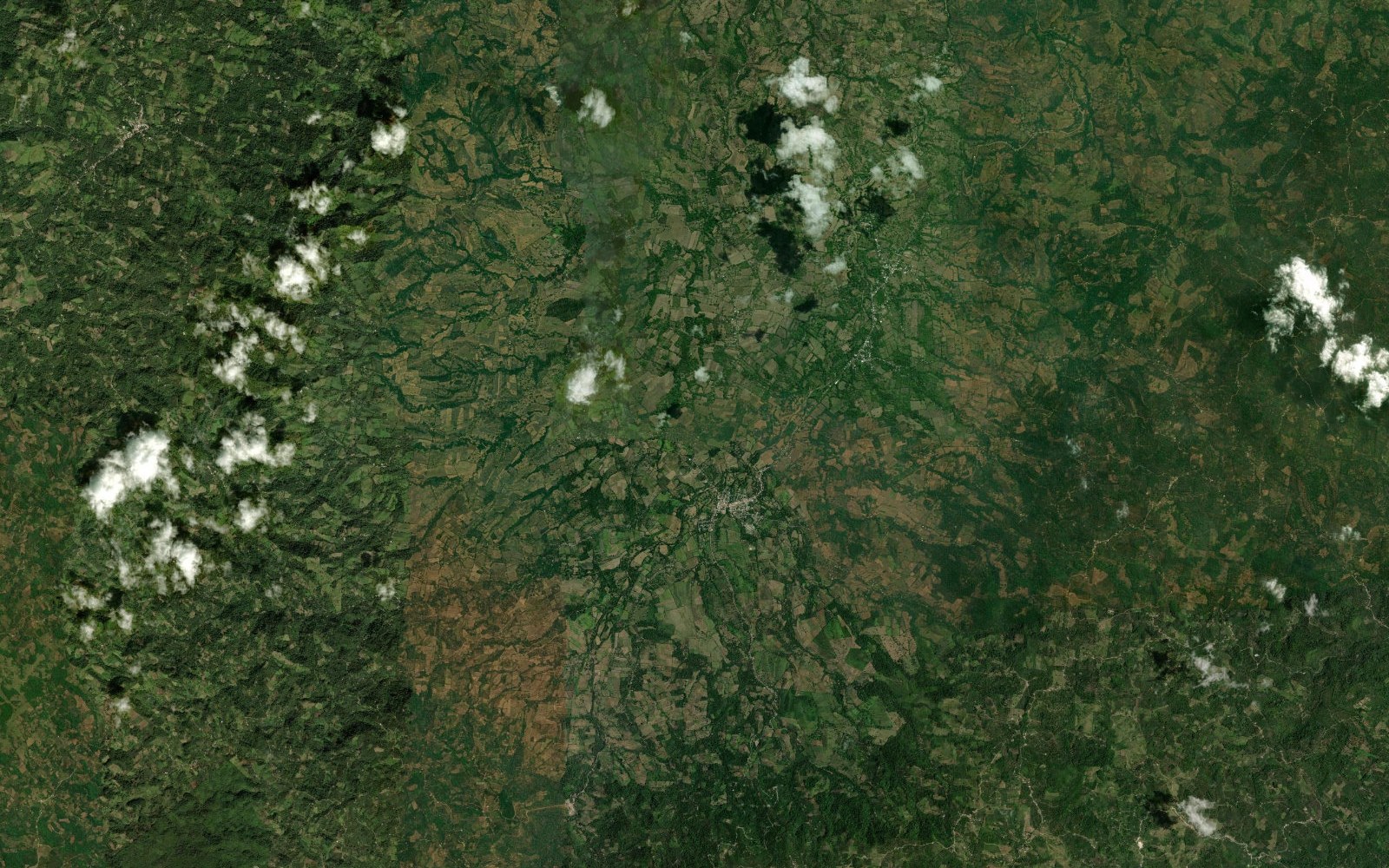
Satellite view of the 14 km Pantasma crater. Esri World Imagery
A chondritic asteroid from the main belt struck the volcanic highlands of northern Nicaragua. Shock pressures exceeded 30 GPa. Temperatures rose above 2,000 °C. Target rock melted into glass, some of it flung as far as Belize — 530 km to the north.
The crater that remains is about 14 km across, centred near 13.36°N, 85.95°W in the municipality of Santa María de Pantasma, Department of Jinotega. It is young for a structure this large. Two ⁴⁰Ar/³⁹Ar plateau ages on impact glass, published in 2019, give 815 ± 11 thousand years. A 2021 joint age on Pantasma glass and Belize glass is 804 ± 9 thousand years. Together they place the impact at about 800–815 thousand years ago.
Erosion in this wet highland has softened the rim, but the circle is still obvious from the air and on topographic maps. The valley floor is a working agricultural basin. The mountains around it — 600 to 1,100 metres — are the ruined walls of the impact.
Select a feature
Read the basin
A 14 km circle of mountains, 600–1,100 m. Outward-dipping volcanic flows. The walkable edge of the event.
Read the landscape
That is roughly how Leo Kowald described the crater floor in 2006, working only from Google Earth and maps. The basin is not level: it tilts down toward the north-northeast, where the Río Pantasma leaves the circle. We re-drew his observation from open elevation data.
Source: Leo Kowald, Pantasma.com ↗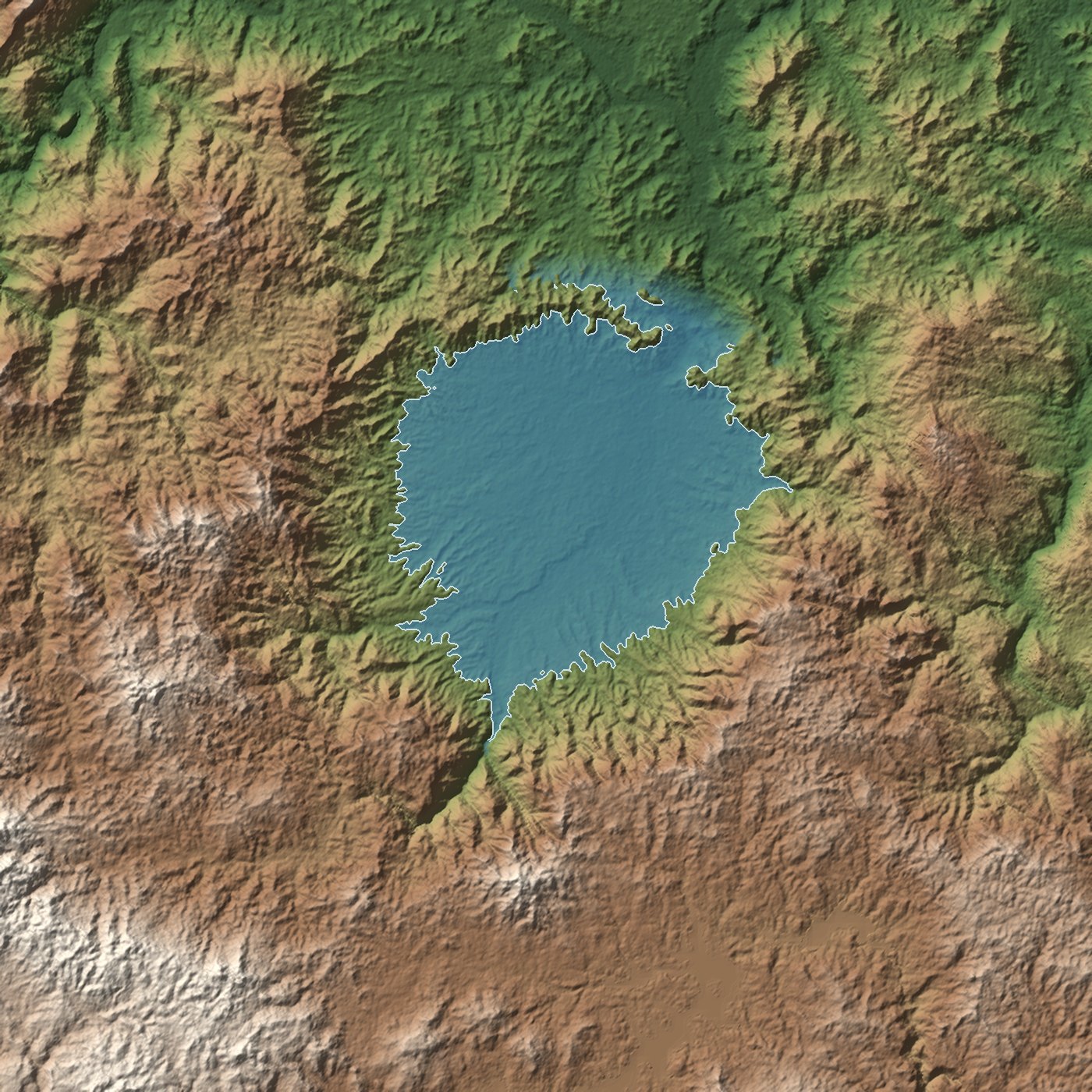

Nicaragua is volcano country: a young chain of volcanoes runs along the Pacific side, and the northern highlands around Pantasma are themselves old volcanic rock. INETER’s geologists had noticed the valley but assumed it was volcanic. Kowald pointed out that volcanism in this region had ended millions of years earlier, and that the circle sits across the mountain slope as randomly as an impact would. Only rocks could settle it, and in 2016–2019 they did.
Source: Leo Kowald, Pantasma.com ↗Then and now
Drag the handle. Left: an illustration of what a freshly formed crater of this size typically looks like in cross-section. Right: the real profile today, from elevation data. Erosion has lowered the rim, filled the floor and opened a gap where the river escapes.
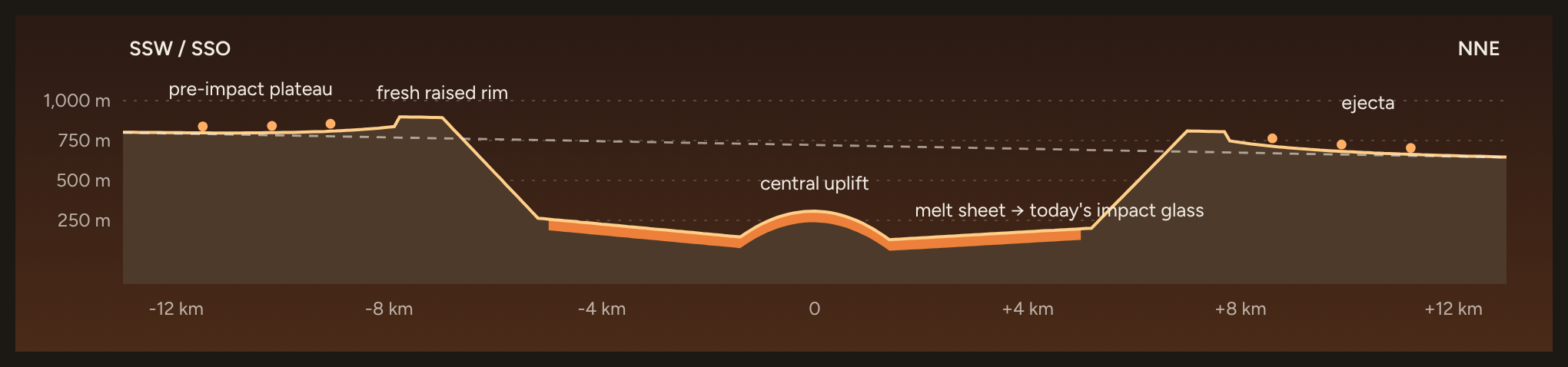
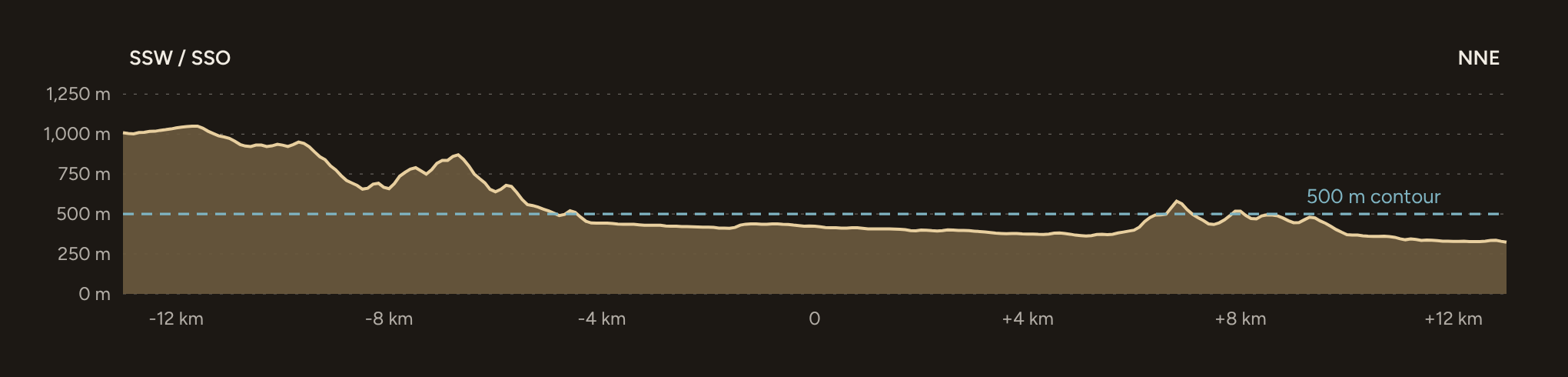
IllustrationLeft panel is a schematic using typical proportions for a ~14 km complex crater on Earth (rim-to-floor depth, central uplift, melt sheet); it is not measured for Pantasma. Right panel: SRTM elevations (NASA/USGS, public domain). Both 3× vertical exaggeration, same axes.
Lechatelierite (almost pure silica glass) and water content below 300 ppm — too dry to be volcanic.
High-pressure polymorphs of quartz and zircon. They form only under shock, not ordinary volcanism.
Polymict breccia from the crater centre carries an ε⁵⁴Cr signature of an ordinary chondrite.
Oligocene volcanic layers around the rim dip away from the basin — the geometry of an impact, not a caldera.
A possible ejecta blanket includes Paleozoic rocks lifted from hundreds of metres below the surface.
Geomorphology and erosion models match an 800-thousand-year crater, not a Tertiary volcano.
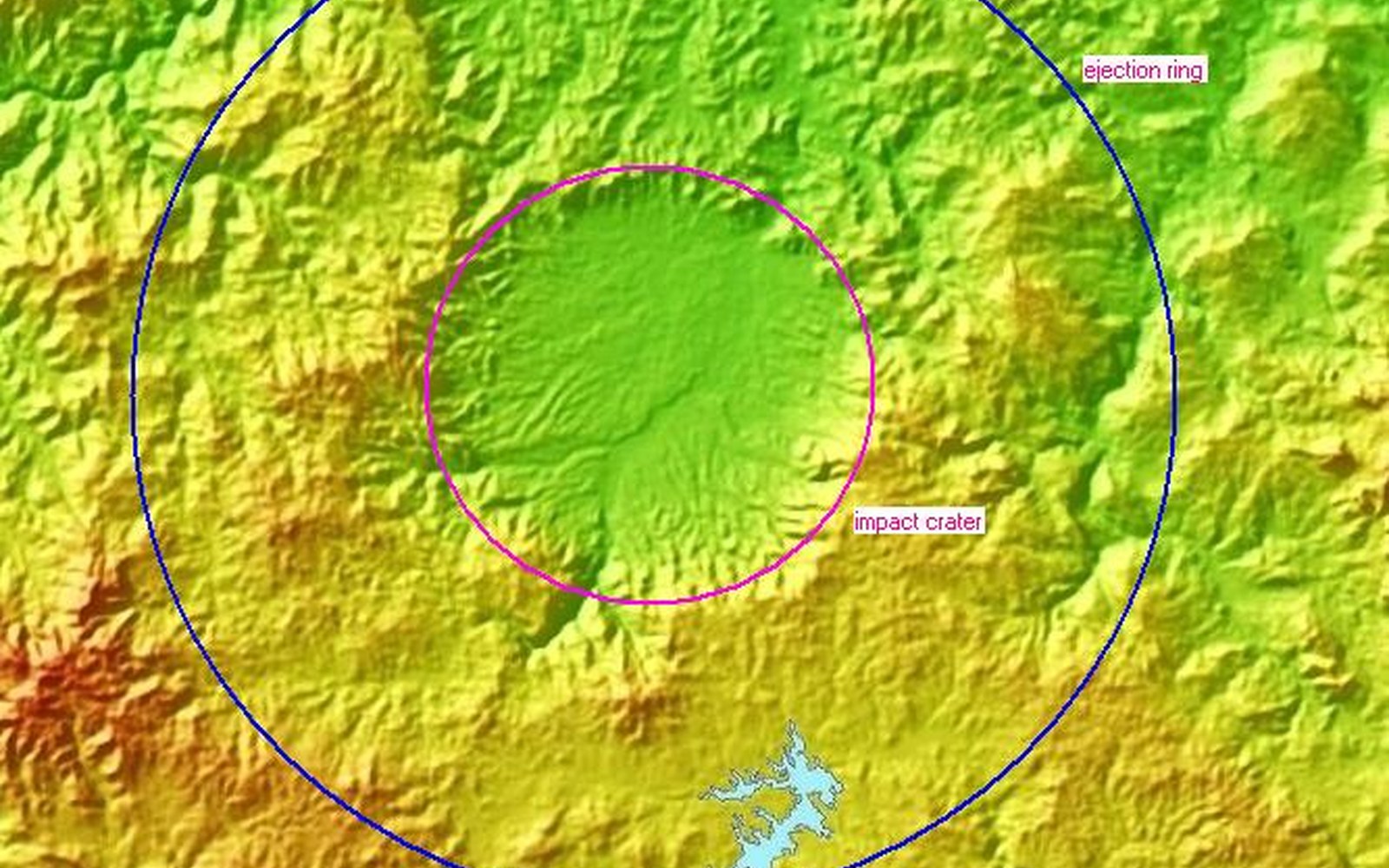
Shade relief of the crater, with an inner rim and a wider ring. Not a photograph of impact glass. Shaded relief: Dr. Wilfried Strauch, INETER (Instituto Nicaragüense de Estudios Territoriales). Shared with and first published by Leo Kowald on Pantasma.com ↗.
Pantasma is one of only three well-dated impact craters larger than 10 km known to have formed in roughly the last 1.1 million years, with Zhamanshin and Bosumtwi. The next-youngest of that size, El’gygytgyn in Siberia, is about 3.6 million years old.
Ghana
10.5 km · 1.13 ± 0.10 Ma · source of the Ivory Coast tektites
Kazakhstan
~14 km (diameter debated) · 0.91 ± 0.14 Ma
Nicaragua
14 km · 815 ± 11 ka · first in Central America · Belize tektites
Correction
Greenland
31 km, under the ice. Once thought young; dated in 2022 to about 58 million years (Kenny et al., Science Advances). Not a young giant after all.
Ages: Schmieder & Kring (2020), Astrobiology 20; Rochette et al. (2019, 2021); Kenny et al. (2022), Science Advances 8.
Petroleum geologist Jean Cornec documented a field of distal impact glasses — tektites — in western Belize. Argon ages, chemistry, and isotopes match Pantasma. The pair is the American analogue of Bosumtwi and the Ivory Coast tektites: one crater, a glass strewn field hundreds of kilometres away.
2006
Leo Kowald, a German mathematician and amateur astronomer, notices the circular valley on Google Earth while preparing a trip with Pan y Arte, and publishes the impact idea on his website in April 2006. Read the full story →
2009
Rolando E. Téllez begins field work and collecting impact glass, tektites, and breccia.
2009
An expedition by ASTRONIC, the Nicaraguan association of astronomers and astrophysicists, visits the valley and reports that its rocks point to a meteorite impact (reported by the magazine Envío, September 2009).
2010
Geologist Jean H. Cornec reports impact glasses (tektites) about 800,000 years old in western Belize, roughly 500 km to the north-west.
2016
First scientific presentation at the Meteoritical Society meeting in Berlin. Field campaign collects the samples that prove the impact.
2019
Rochette et al. publish in Meteoritics & Planetary Science. Pantasma enters the confirmed impact-crater record.
2021
Follow-up work ties the Belize tektite field to the crater. A joint age on Pantasma and Belize impact glass is 804 ± 9 ka.
2023
Pantasma is added to the Earth Impact Database, the reference list of confirmed impact structures, as reported on Pantasma.com (citing the 54th Lunar and Planetary Science Conference, March 2023).
2025
Gravity modeling proposes an oblique north–south impact at about 30–45°, a preserved rim, a central Bouguer anomaly of about −30 mGal, and a possible second-ring or ejecta signature. ADS 2025psss.confE.124F.
2026
Darling F. Castro-Hidalgo publishes the first new geologic map of the crater: Nueva cartografía litológica de la estructura de impacto Pantasma y alrededores (Nicaragua). Revista Geológica de América Central, Vol. 74 (2026).
Darling F. Castro-Hidalgo, a PhD student from Managua working in Mexico (Universidad de Guadalajara, Centro Universitario de la Costa, Puerto Vallarta), published the first new geologic map of the crater: Nueva cartografía litológica de la estructura de impacto Pantasma y alrededores (Nicaragua). Revista Geológica de América Central, Vol. 74 (2026), published 16 March 2026. Coauthors: Marcel Chow-Martínez, Pierre Rochette, Arturo Muñoz-Barboza.
That 2026 mapping describes an outer structural rim about 20 km from the centre, monomict megabreccia, suevite-type polymict breccias, and a magnetic signature of impact demagnetization (Castro-Hidalgo et al. 2026).
A 2026 Zenodo preprint by Kornaga argues a hybrid impact–tectonic origin. That text is not peer-reviewed. The peer-reviewed literature treats Pantasma as a confirmed impact crater.