The discovery
A ghost on the map.
In 2006 a German mathematician, flying over Nicaragua in Google Earth, noticed a circle nobody had explained. Thirteen years later the rocks proved him right.
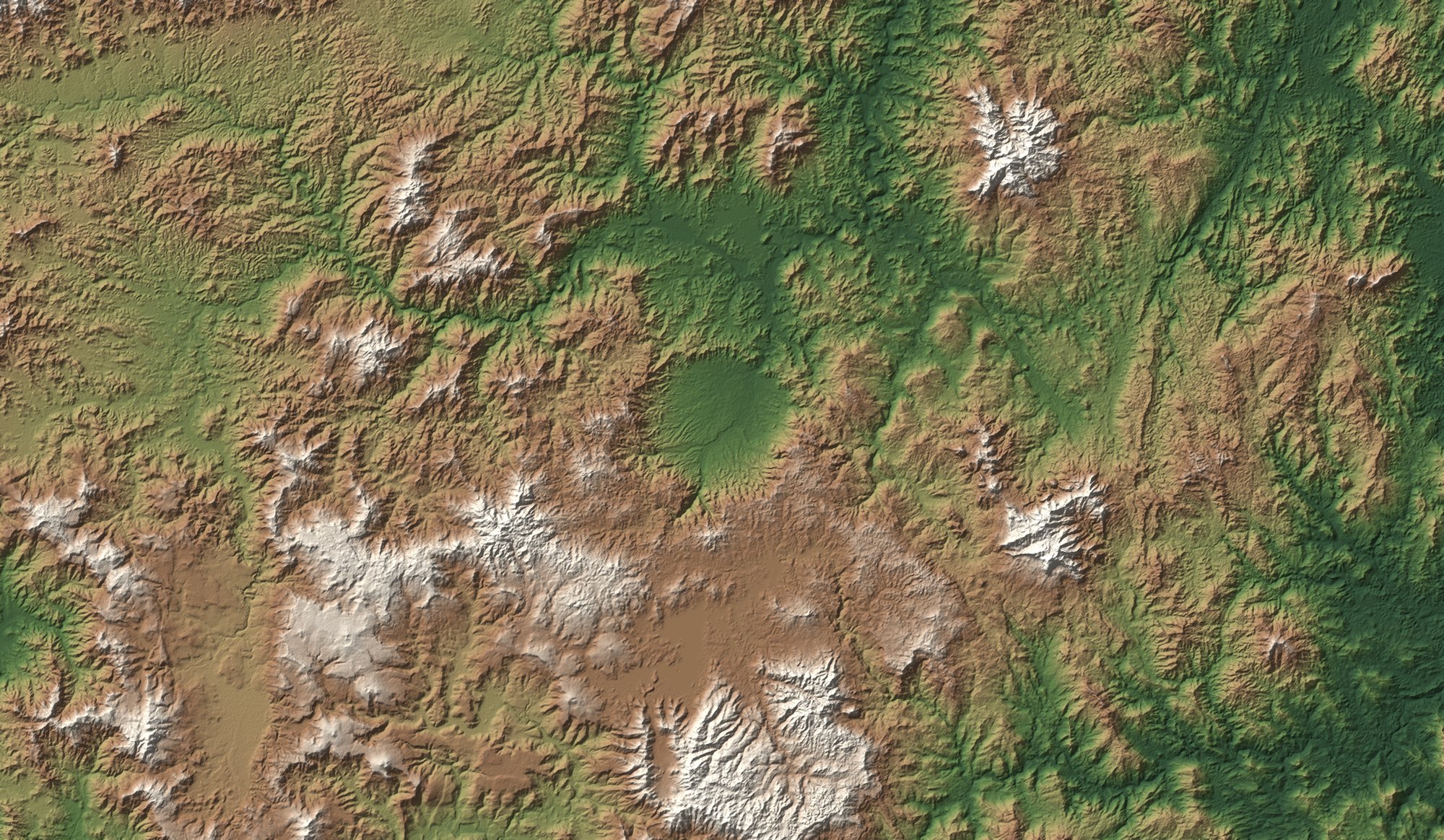
Data graphicShaded relief from SRTM elevation data (NASA/USGS, public domain). Not a photograph.

This story is his
Leo Kowald
Dipl.-Math., amateur astronomer — the first to propose, in April 2006, that the Pantasma valley is a meteorite impact crater.
This page summarises and paraphrases Leo Kowald’s website, Pantasma.com, where he first published the idea and has kept a log of the research ever since. Short quotations are his own words. Please read the original.
01
February 2006
A circle on the screen
Kowald was preparing a two-week trip through Nicaragua with Pan y Arte, the aid organisation founded by the Austrian actor Dietmar Schönherr. Before leaving, he took a virtual “flight” over the north of the country in Google Earth and saw an almost perfectly round valley, about 12 km across, in the department of Jinotega.
His trip never took him near it. Everything he wrote that April came from satellite images, maps, and a shaded relief map that Dr. Wilfried Strauch of INETER, Nicaragua’s geosciences institute, kindly sent him.
Source: Leo Kowald, Pantasma.com ↗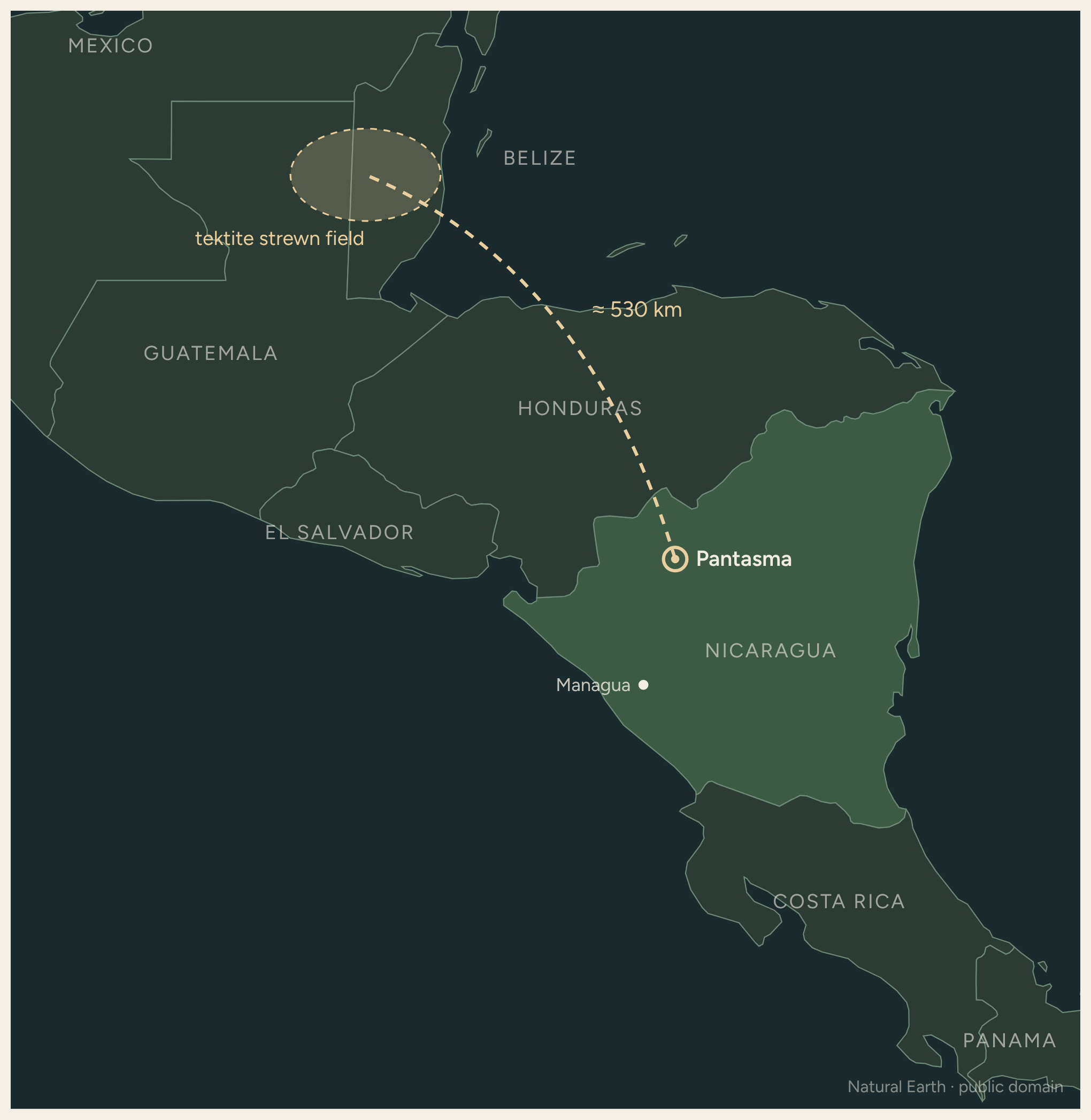
02
Reading a crater from a desk
An astronomer’s eye on a geologist’s question
Nobody seemed to have written about the valley. INETER’s geologists had noticed it, Strauch told him, but assumed it was volcanic. Kowald, used to looking at craters on the Moon and planets, read it differently: the circle sits randomly across a mountain slope, the way an impact would; its narrow northern arc does not look like the wall of a collapsed caldera; and the region’s volcanoes had gone quiet millions of years earlier.
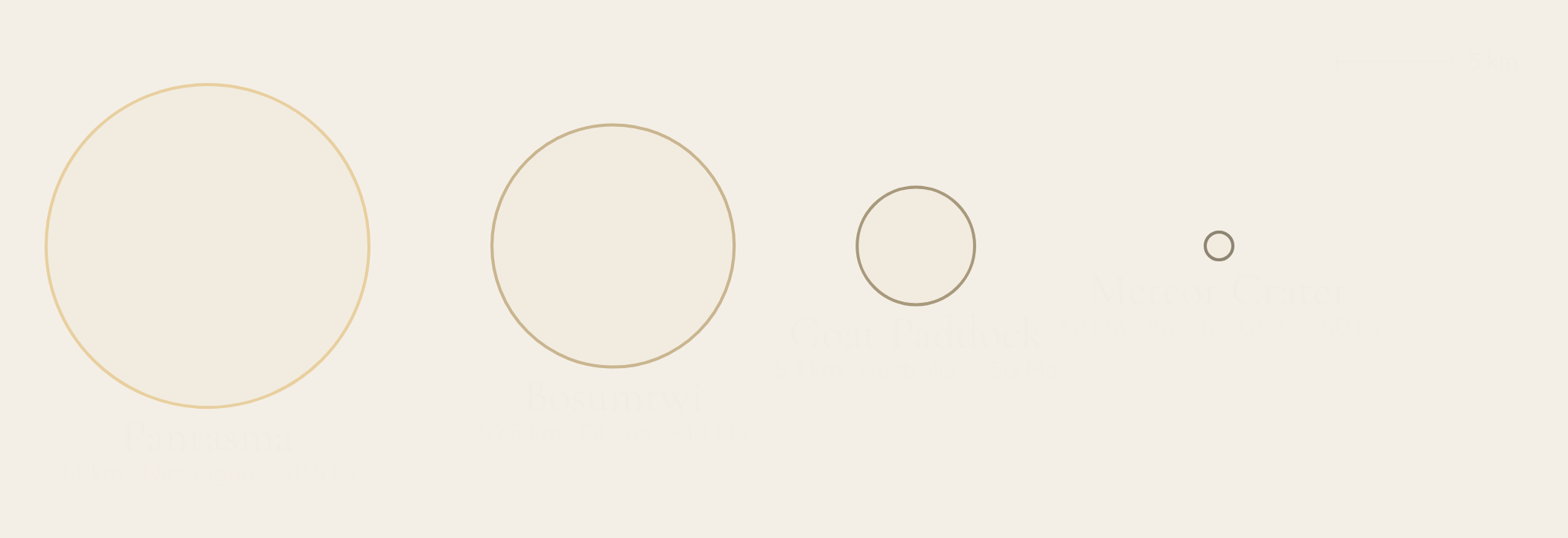
He compared it with Goat Paddock in Australia and Lake Bosumtwi in Ghana, and noted the missing central peak, perhaps buried under sediment in this rainy climate. He was candid that he was not a geologist, and said only a geologist could decide the question, by finding shatter cones, suevite or tektites.
Source: Leo Kowald, Pantasma.com ↗“Should I only be fooled by a Phantasma?”
Try his rule of thumb
“Crater by 20”
Kowald used the rough rule that an impactor is about one-twentieth the size of its crater. For a 12 km circle, that meant a body more than 500 m across.
Crater12 km
Impactor (rough)≈ 600 m
A back-of-the-envelope rule only. Real impactor size depends on speed, angle and density; researchers use scaling laws.
Source: Leo Kowald, Pantasma.com ↗03
Prediction vs. proof
What he guessed in 2006, and what the rocks said
Kowald’s 2006 reading, paraphrased from Pantasma.com, against the peer-reviewed findings since. Tap a card to flip it.
04
From a hunch to the record
Seventeen years, one circle
- Kowald / Pantasma.com
- Field science
- Publication & recognition
1. 2006
The idea goes public
In April, Kowald publishes “PANTASMA – a young meteorite impact crater in the old volcanic landscape of Nicaragua?” on his website, in four languages.
Source: Leo Kowald, Pantasma.com ↗2. 2009
First expeditions
ASTRONIC, the Nicaraguan association of astronomers and astrophysicists, visits the valley and reports rocks consistent with an impact (Envío, September 2009). Rolando E. Téllez begins field work and collecting impact glass.
Source: Leo Kowald, Pantasma.com ↗3. 2010
Glass in Belize
Geologist Jean H. Cornec reports tektites about 800,000 years old in western Belize, roughly 500 km north-west of Pantasma.
Source: Leo Kowald, Pantasma.com ↗4. 2016
The samples
A team led by Pierre Rochette (CEREGE, Aix-Marseille) works in the crater in February and presents first results at the Meteoritical Society meeting in Berlin.
5. 2019
Proof in print
Rochette et al. publish the evidence in Meteoritics & Planetary Science: a ~14 km impact crater, about 815,000 years old.
6. 2021
Crater and glass joined
The Belize glasses are shown to be tektites from Pantasma; joint age 804 ± 9 thousand years.
7. 2023
On the official list
Pantasma is added to the Earth Impact Database, as reported on Pantasma.com (citing the 54th Lunar and Planetary Science Conference).
Source: Leo Kowald, Pantasma.com ↗8. 2025
Looking underground
Gravity modelling proposes an oblique north–south impact and a possible second ring or ejecta signature.
9. 2026
A new geologic map
Darling F. Castro-Hidalgo and colleagues publish the first new lithological map of the structure.
Entries with a source link are drawn from Pantasma.com; the others follow the peer-reviewed sources listed on our Credits page. Credits
Go to the source
Read Leo Kowald in his own words
These links open Pantasma.com. The files are hosted by Leo Kowald; we link to them rather than copy them.
Discovery story after Leo Kowald
Summarised and paraphrased from Pantasma.com (2006–2023). Science after the peer-reviewed sources on our Credits page.